
Technical Bulletins
Refrigerant Leak Management Requirements for Appliances ≥15 lbs
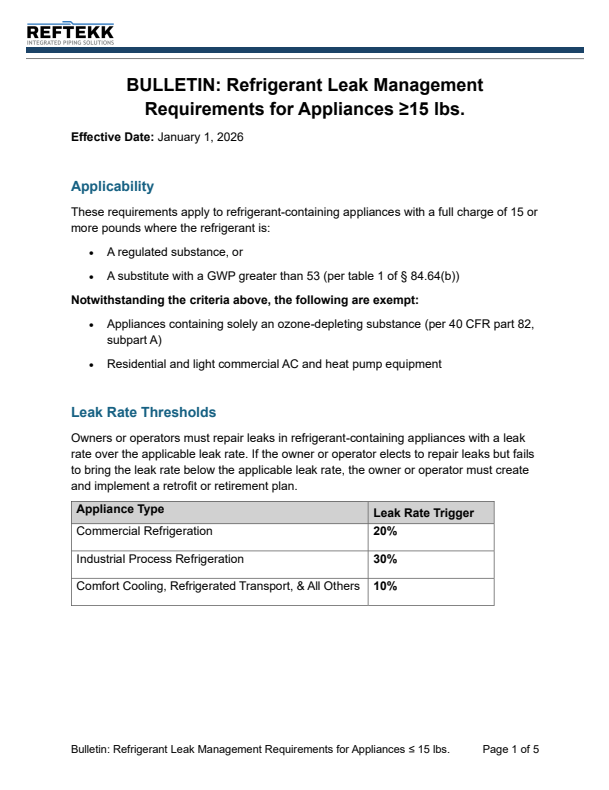
New EPA refrigerant leak management rules took effect January 1, 2026, and apply to any refrigerant-containing appliance with a full charge of 15 pounds or more — including commercial VRF systems — where the refrigerant is a regulated substance or a substitute with a GWP greater than 53. The regulations establish leak rate thresholds by appliance type (10% for comfort cooling systems, 20% for commercial refrigeration, 30% for industrial process refrigeration), and require owners and operators to repair, retrofit, or retire appliances that exceed their threshold.This bulletin summarizes the full compliance framework: leak rate calculation methods, repair timelines (typically 30 days), required verification testing, post-repair inspection schedules, recordkeeping requirements (most records retained for 3 years), and EPA reporting obligations. Appliances leaking 125% or more of their full charge in a calendar year must be reported to the EPA annually. While this bulletin is intended as a practical reference, readers should consult the full regulatory text at 40 CFR § 84.106 for complete compliance requirements. Click the Bulletin Image to read the full article.
Insulation For VRF Being Improperly Specified - Tailored For IECC (2012-2021) And ASHRAE 90.1 (2010-2019)
%20and%20ASHRAE%20(2010-2019).png)
Most engineering firms and contractors are under-specifying insulation on VRF refrigerant piping — and many don't realize they're out of compliance with both energy codes and manufacturers' installation requirements. This bulletin covers the minimum insulation thicknesses required by IECC (2012–2021) and ASHRAE 90.1 (2010–2019) for VRF liquid lines, suction lines, and hot-gas lines, with specific guidance on how pipe size and refrigerant temperature affect the requirements.Beyond thickness, material selection is equally critical. All VRF manufacturers require closed-cell elastomeric foam rated for continuous operation at 248°F — a threshold that common materials like NBR rubber and polyethylene foam cannot reliably meet. EPDM insulation, with a continuous rating of at least 257°F, is the recommended solution. Contractors and building owners who meet current ASHRAE 90.1 standards may also qualify for significant 179D tax deductions under the Inflation Reduction Act. Click the Bulletin Image to read the full article.
Insulation For VRF Being Improperly Specified - Tailored for Oklahoma Based on 2006 IECC

This bulletin is tailored for mechanical contractors and engineers working on projects governed by the 2006 International Energy Conservation Code, which is still the adopted standard in Oklahoma and several other states. The 2006 IECC has straightforward refrigerant piping insulation requirements — 1" for tubing ≤1-5/8" and 1.5" for larger sizes — but these minimums are frequently overlooked or ignored in the field.The bulletin also covers manufacturer requirements for insulation material (closed-cell elastomeric foam, rated for 248°F continuous), explains why EPDM is the preferred choice for VRF systems, and includes bonus guidance on the ASHRAE 90.1 thicknesses that qualify for 179D tax deductions under the Inflation Reduction Act — which are stricter than the 2006 IECC minimums and worth specifying on projects where the tax benefit applies. Click the Bulletin Image to read the full article.
Insulation For VRF Being Improperly Specified - Tailored for California Title 24

California Title 24 sets some of the most demanding insulation requirements in the country for VRF refrigerant piping — stricter than ASHRAE 90.1 — yet improper specification remains widespread. This bulletin details the minimum insulation thicknesses from Table 120.3-A of the 2016 California Energy Code, broken down by line type (liquid, suction, and hot-gas) and tubing size, with important notes on how high operating temperatures on hot-gas lines can push requirements even higher.As with all VRF applications, material matters as much as thickness. VRF manufacturers universally require closed-cell elastomeric foam rated for at least 248°F, and EPDM — with a continuous rating of 257°F or higher — is the only material that reliably meets this standard over the life of the system. Contractors meeting ASHRAE 90.1 standards (note: Title 24 requirements exceed 90.1 minimums) may also be eligible for 179D tax incentives under the Inflation Reduction Act. Click the Bulletin Image to read the full article.